Tuesday, 26 March 2013

Border crossing into Bolivia


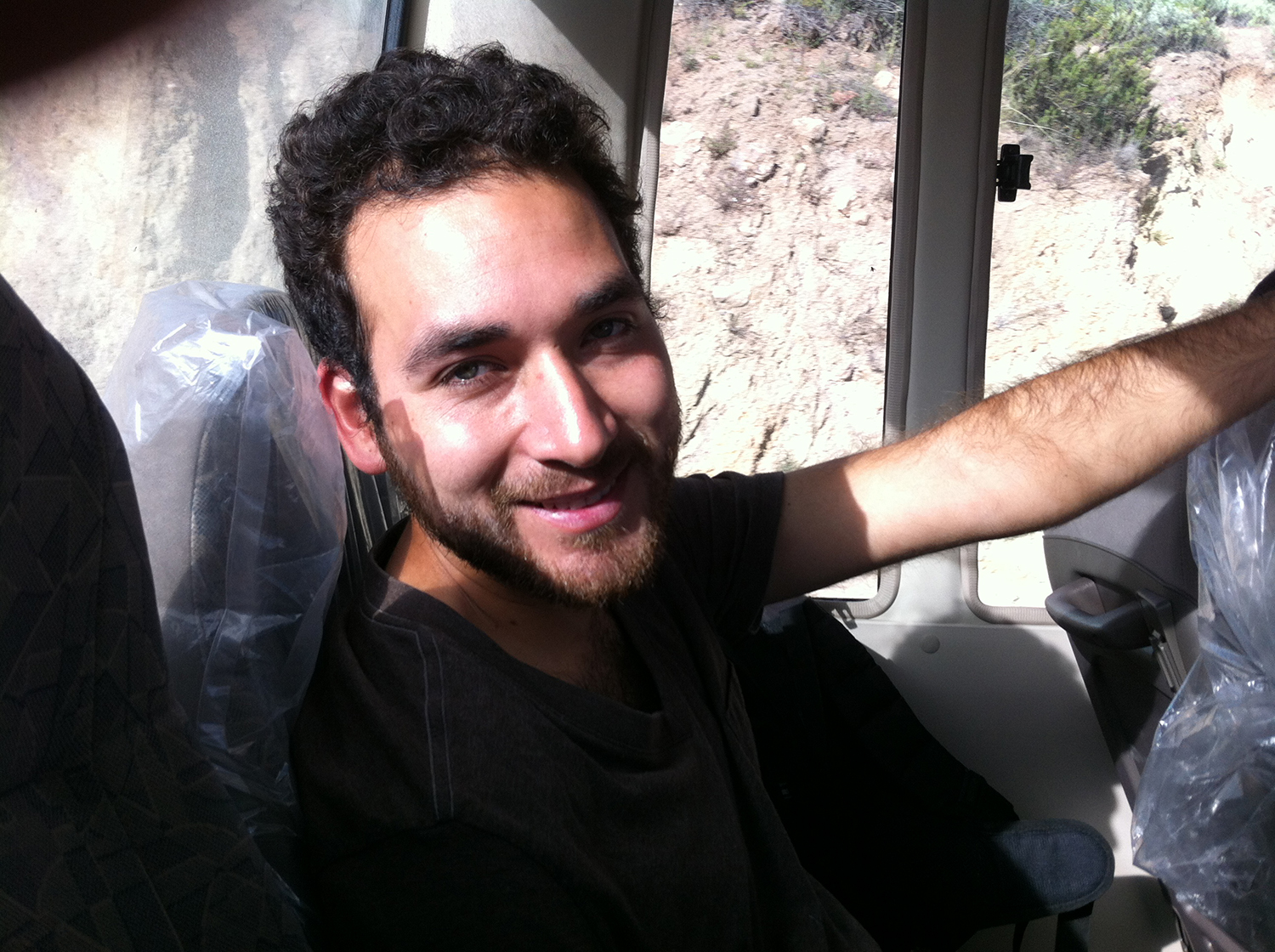
So one border crossing later (my first of the trip!) and about 16 hours on perhaps the least comfortable bus ride so far and I am in Cochabamaba, Bolivia, yay! A new country, new sights, smells, ryhthyms, exciting :-)


This was perhaps the most peculiar bus ride too: from the rudeness of the bus driver when David checked the leaving time with him; to the unpredictable leaving time itself that had me and David and all the other passengers waiting in the street in Arica from the scheduled time of midnight until 2am; to the random and illogical seat numbering that took over half an hour to sort out and left one passenger seat-less and understandably very angry (he came with us in the end, riding up front with the driver); to the various bus workers sleeping along the floor, the back seat ridge, and the underbelly luggage rack; to the breaking down of the toilet early on, that left me desperate for the loo at the unfortunate timing of the queues of the border crossing at Chungara –Tambo Quemado; to the strange sensation of feeling almost drugged that had me drifting in and out of sleep all of the Sunday day in between momentary steps down off at various loo and wheel-changing stops, perhaps a combined effect of high altitude and lack of sleep during the cold of the night passing through the Altiplano with no blanket (note to self: before next overnight bus journey check if there are blankets available and if not wither get a hold of one, or wear multiple layers of clothing!) 


From the moment of first crossing the border I felt the change into a new culture, a new flavour.  The biggest change is perhaps the climate, which has been sunny during the day but rainy later on.  Light rain drizzled through my first evening with lightening flashing at intervals across the sky, which is apparently common at this time of year, and as I write heavier rain is pattering on the roof.  This is obviously a huge change to the water-short northern desert regions of Chile, where it is said to rain once a year for half an hour. 

Wherever we stopped there were always folk selling food, and I had my first taste of typical Bolivian food at the border when I ate a mix of mote, papa and chicharrón (boiled corn, potato and pork cracklings) Most food sellers seem to be seated on the ground, with a large basket or plastic cooler between their feet, usually wrapped in the brightly coloured typical woven blankets that are used to carry the containers on their backs when they walk to and from the selling spot.  (The same blankets are also used to carry babies and young children on the back.) Most of the food sellers are indigenous Bolivians, whose first language is Quechan and who wear the traditional woven clothing, with the women wearing their hair in two thick long plaits topped usually by a typical Bolivian bowler hat decorated with ribbons.

After finally reaching Cochabamba around 6pm I made my way to the first guide-book listed hostel that answered and had a spare room, Hostel Fontaine (that turns out to be more Hotel than Hostel, seeing as I have a private room, bathroom , TV (that I have yet to turn on!) and fridge (empty and doesn’t seem to work even when plugged in).  After moving from the first room I was given because all the plug sockets were broken, I got happily settled into a room with a patchwork blanket style throw and an interestingly stylized painting of a harpist on the wall... the harp and patchwork two coincidental touches that made me feel very at home once I noticed them. :-)


The highlight of my first night in Cochabamba was catching up with my brilliant old friend Lucy Pickles, who’s been out here for the last few months volunteering with Tearfund.  I was shocked to hear how severe her recent bout of food poisoning was, landing her in hospital twice with dehydration.  Luckily she’s now fully recovered, or at least enough for us to share a damn good pizza, European style (After a few months of being here Lucy says she’s over the typical Bolivian food!)


I’m already one day into my stay and after wandering the streets today am full of more thoughts and observations to share, but for now, with it being 4.35am and an early start tomorrow to catch Lucy for breakfast, let’s leave it at this, and a couple of photos giving a taste of the vibrancy and colour of this hectic Bolivian city.


Enjoy!
Big love from Bolivia
:-)

National March for Recuperation and Defence of Water: 22nd April


Water is not a commodity,
Water is a right, 
Water is life.


Stop-motion animation created in response to the water issues in northern Chile, made in collaboration with David Concha, who came up with the visual concept of money pouring from the tap in place of water.


Using real Chilean notes and coins, (the 10 luca note was particularly battered by the end of the shoot!), a glass, a very patient-Temescal-focused model in the form of David himself, and a particularly handy clothes peg, we shot the stop-motion in David's kitchen sink at his home in Arica with some clever camer-balancing-on-towel action.

MINES EXPLOIT WATER
Mining process use huge volumes of water, having a brutal impact and incompatible with agriculture. Río Huasco is drying out.

 MINES CONTAMINATE WATER
Water in Arica is contaminated with more than the 'permitted' amount of 0.001 mg/l of arsenic, 
which causes cancer, heart disease and lung disease.

MINES DON"T PROVIDE MUCH WORK
The Valley de Lluta dives work to 6,000 people 
and the mining company offers only 230 jobs for only 10 years

More information:

National march 22nd April 2013 for the recuperation and defence of water:
12 noon, La Moneda, Santiago

www.facebook.com/PorLaRecuperacionyDefensaDelAgua
www.recuperacionydefensadelagua.blogspot.com
Email: recuperamoselagua@gmail.com


Let's get together! 22nd April 2013
The national march for the defense and recuperation of water.
Everyone together in Santiago 12 noon La Moneda

www.radioandina.cl
www.ecosistemas.cl
www.facebook.com/brigadasoshuasco

"Saqueando" escrito y cantado por Juan Carlos Labrin
www.soundcloud.com/juan-carlos-labrin-cantautor

Thanks to David Concha and Juan Carlos Labrin for their collaboration.
:-)

ONE: David Concha Astorga


David Concha, the key Chilean link in the chain of friends of friends that got me so settled in La Serena, and the source of the phrase La Solidaridad de los Viajeros (which, happily he’s given me persmission to use for the ONE postcard project, yay!) David is friend of Sarah from their days flat-sharing in Spain where they were both on student exchanges, and Sarah is old uni mate of my old flat mate and art college friend Steve. Brilliant! :-)

And wow, what a gorgeous human being David Concha is... massively intelligent, hugely motivated politically and socially, kind, generous and playful with paint, David has a cheeky smile about him, a thirst for good Chilean wine and a willingness to entertain with daft imitations of international Spanish accents.. as I learned to my delight during our long midnight wait for the bus out of town - a moment when I also introduced Moley to him.. so Lily and Amelie, you'll be happy to see below that they got on pretty damn well! ;-)


David studied Psychology and Social Sciences and is currently working on his final year practical investigation at Arica’s University of Tarapacá where he is also President of the Students’ Union.  He and his student and activist colleagues are putting huge amounts of energy into the local issues of higher education and water and the heartfelt passion I witnessed them working with was truly inspiring.  It was a real privilege to be invited to share a couple of days alongside David in the intensity of his day-to-day life in Arica.  Like I said to him, by the end of Saturday my head was spinning and I felt like I had learned a huge amount.

Despite being full of a cold and having to get to work for 9am, in typically hospitable Chilean style David met me from the bus station early-doors 7.30am Thursday 21st.  In the hours he was at work and for most of the afternoon I was catching up with writing and photo-editing... oh and also cooking a cold-curing soup spiced with so much ginger and garlic that it had us both snotting enough for David to name it mocos/snot soup! ;-)

So really it was the next morning when we hurled full swing into David’s intense routine, which felt like it didn’t really stop until late Saturday night!  Friday morning, after having secured my bus ticket across the border to Cochabamba, we headed to the University Campus and listened to a talk introducing the social and economic context of Chile and the local environmental issues facing Arica and neighboring communities in Valley Lluta.

Committee of the Defence of Valley Lluta, Social-environmental movement of Valley Huasco invite you to unite in a meeting with communities of Valley Lluta and the Mayor of Putre to discuss the problems with water and the mining project "El Puma" en ACHS.

There were two main speakers; Alvaro Torro and Juan Pablo Orrega.  Juan Pablo is a psychologist, environmentalist, activist, and spokesman for EcoSistemas, Chile.  Alvaro Torro is a lawyer and activist who works for a socially focused organisation in Santiago to oppose the mega-mining and thermoelectric projects that are causing such huge environmental damage in Chile.  He was honest in saying that in their fights there tend to be more losses than victories, but also spoke of a number of significant successes in drawing a halt to the activity of some huge projects whose activity they were able to prove illegal due to the extreme levels of contamination being caused.  Very encouraging for the locals here in Arica and Putre who are fronting the fight against the mining project Las Pumas, which is due to commence activity in Valle Lluta on 9th April.

This talk was one of many that Torro and Orrega are presenting in the tour that they are currently on, spreading information and knowledge about the truth of environmental issues in Chile.  This is in part an attempt to combat the problem of disinformation spread by the marketing strategies of mining companies, which give the illusion that firstly they are socially responsible (the same tricks we’d heard about at the Huasco meeting of giving short-term gifts to communities to get them sign away their land rights) and secondly that they are huge employers of local workers (not true – Valle Lluta gives work to 6,000 agricultural workers, whereas the mining company will only offer 250 workers posts for just10 years)

Part of the intention of spreading information is to empower local indigenous communities so that they know their rights and are aware of the danger of signing away land rights to mining companies for short-term financial gain.  Within communities where land has already been sold and projects are already underway or on the brink of starting, such as Los Pumas in Valle Lluta, Torro and Orrega are informing locals of the alternatives to a Chile based on mines and encouraging them to mobilize and take action by joining the fight against the mines.  It was refreshing and inspiring to hear Juan Pablo Orrega speak of a Chile whose economy would be based on higher education and healthcare of such high quality that foreigners would come and pay to study in Chile, and disseminated eco-tourism.  It was then even more encouraging to hear Alvaro Torro follow this up with the practical invitation to join the fight by gathering evidence of contamination to take the fight law courts. 
 

Torro and Orrega’s mission is supported and strengthened by the activity of other activist groups, such as David and the other students at Tarapacá, and the Hari Krishna community based at Valle Lluta’s Eco Trulycommune, where we slept overnight in gorgeous adobe huts on our way up into the mountains to visit the community in Putre for the 3rd of the water issue talks on the Saturday afternoon.  Thanks to Nitai and the other monks at Eco Tuly for their hospitality. 

There was also a young lad with us throughout the talks on the Friday who was from Iquique and whom the Ecuadorian monk kept referring to as “coming from the future”.  This was in the sense that the environmental damage wreaked by the mines in Iquique, which is a town a few hours south of Arica, is already so severe that there are apparently large numbers of  people with cancer and others with strange spots and marks on their skin.  This lad and his dad have been making documentaries about the issues of the mines in their region under the name Traversía Norte, you can watch their videos such as this one online on Youtube:


David and I were picked up from the highway by a bus-full of Arican activists headed by Cesar Huanca Chambe, and continued up into the Valley, arriving at the 3,015m altitude of Putre around midday, where a large part of the community are of indigenous Aymara heriatge.  It was a real insight to accompany David, Cesar and his colleague from Radio Andina FM 100.1 as they chatted with Putre local and newcomer to the radio-scene Little Tommy (in reality a towering height of somewhere far over 6ft) about potential radio collaboration.  Radio Andina was established in Arica just two months ago, specifically with the intention of raising awareness about social issues, with the main focus on the mines and the resulting water issues.  Again their focus is on combating disinformation so it is vital to them that their programs have as wide an audience as possible, and the hope is that with the collaboration with Tommy they will reach far into the rural communities.  After having notices a coupe of workers in the fields that morning with the radio blasting our music it was interesting to hear from Tommy that peak listening time in rural areas was indeed early morning as well as evenings after work.

As representative of the student movement, David spoke at the Putre meeting of how the students see their struggle as not just for the educational issues so personal to them, but also as the struggle for water which will affect the futures of all Chileans and the generations to come.  On behalf of the student movement he offered words of support for the community of Valle Lluta, and encouragement in joining the students and Arican community in the streets in the upcoming marches, and above all identified the importance of solidarity and it’s power to overcome even the hefty opponent of large business and cash. 
 

David and a group of student friends had also offered their support to worker’s syndicate Pioneer in Arica the previous afternoon, at an assembly in the street where the workers had gathered to plan their movements at a march the following day.  This was a syndicate of workers who handle transgenic seeds, (the ethics and issues of transgenic seeds in this instance a secondary issue to the humanitarian issue of extremely poor working conditions) and who are on a 6 day strike to demand fairer working conditions are rates of pay.  Touchingly the students had brought along supplies of food for the workers, who they knew would be struggling financially during the days of the strike.

So these really were an intense couple of days, a huge learning curve and a real insight into the severity of these current issues in Chile.  There was, however, also a strong positive message from these days – that of the powerful force of solidarity between different groups fighting from their souls for their human right to a healthy future.

Respect above all - that's how we'll achieve mutual happiness!
(An image and quote photographed on the wall of David's uni, seems pretty symbolic to me of the unity and solidarity that marks the highly developed social consciousness that is so prevalent in Chile.) 

David, thank you so much for inviting me to share these says with you, 
and thanks also for the access to your travellers network...
here’s hoping I can share some of mine with you in the future!
:-)

Monday, 25 March 2013

ONE: Karta Felipe Chavez


Karta Felipe Chavez
 A challenge I overcame: I overcame the Devil
A dream for my future: Peace for all
A hope for the global village: A lot of hope for all

One of my core beliefs in life is that we have to trust our paths to take us where we ought to be at any given time.  This doesn’t negate personal responsibility; we obviously have to make thoughtful decisions and choices, but I truly believe that when we are relaxed and in tune with our instincts, these choices, however haphazard and random they may seem at the point of making them, will take us to the place we need to be and into contact with the folk or experiences we need to meet at any given time.  Folk we may learn from or teach in our own humble way, folk we may share with and exchange ideas with.  Destiny you could call it. 

It certainly felt that way with meeting Felipe.  On the stop-off at Calama, an hour or so from our final destination of San Pedro, we met over the buying of some grapes (we differed in our reaction to them  -I thought they were delicious though I seemed to get a sore mouth from eating too many perhaps?  Felipe thought a few were good but too many were over-ripe).

The final hour of our bus ride was spent chatting, chatting, admiring the views and chatting, chatting.... Felipe talked of this journey as looking to see whether he could move back to Chile from his current home in Barcelona - he in Chilean but has lived outside the country since he was 9, first in London, then the US, now Spain where he has an intense schedule of teaching yoga, studying Chinese medicine, practicing martial arts and painting.

Ours was certainly one of those chance meetings resulting from random decisions that led to fruitful exchange and a happy companionship for the next 24 hours (we’d both randomly come across this new bus company Ciktur, which so far has been the most comfortable service I’ve experienced here).   Our meeting was definitely lucky for me in terms of finding a place to stay in town.... I’d taken my usual casual approach to finding accommodation, looking up options in the guidebook on the bus ride, picking a couple I liked the sound of and heading to check them out on getting into town without booking ahead.  Not wise it turns out when you’re getting into a tourist town as busy as San Pedro (you can tell how busy it is from the sheer number of hostels, hotels and posh touristy restaurants and cafes around the town).  The couple I’d looked up were full and the only remaining beds were hugely expensive, until we got to the hostel Felipe was booked into where there just happened to be one remaining bunk for one night only, perfect, as my plan we to head to Arica the following night. 

So bunk-bed secured, and after heading back to the bus station, bus ticket too, Felipe and I walked out of town towards a river that it turns out has dried out of existence and watched the sun set from a gravelly sandy perch on the edge of a hillock.  Again we chatted, chatted,... watched the half moon and the astonishingly intense stars appear: the Southern Cross, Orion’s belt, the splatter of the Milky Way, even a shooting star that we both spotted ...  and chatted, chatted...  

Felipe shared his understanding of how we are each defined by one main elements, water, earth, fire, air or metal.  Metal people tend to be cold and unfeeling, perhaps explaining the seemingly in-human behaviour of so many folk high up in business or politics, the type of person who can openly talk about the human ‘cost’ of a business project without batting an eyelid... putting monetary gain over human life in an attitude that I will never be able to comprehend.


Both Felipe and I happen to be mainly water (this interpretation is based on your star signs) Water people have characteristics of fluidity, nourishment and often extreme sensitivity (which can make them vulnerable), hence a tendency of water-folk to be drawn to be teachers.  Interesting, then, that both Felipe and I are teachers in our own way, Felipe with his yoga instruction and with my art workshops.
 

Interesting then, too, that in our search for a mission the following day we were both mostly drawn to visit the salt lakes of Laguna Cejar.  Hiring a pair of mountain bikes, loading up with water and nuts (the nuts for me – Felipe was on a morning fast) and caked in sun cream we set off along long desert and salt-lined roads, pretty much straight apart from one right hand turning marked by an isolated tree we’d been told to look out for and that Felipe was much more on the ball about spotting than me.
 

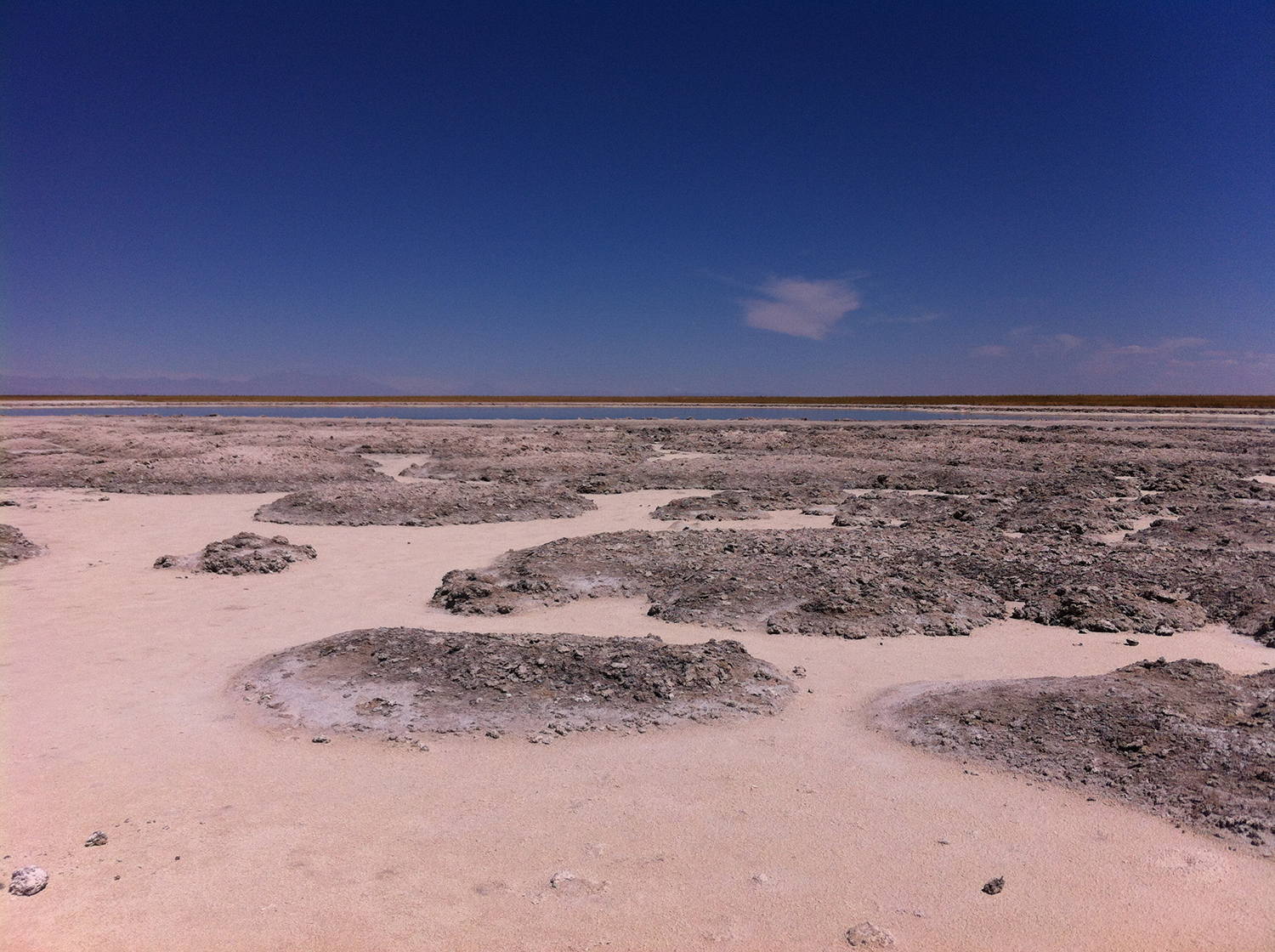
Bobbing around in the salt-dense water at Laguna Cejar was a peculiar feeling that had me laughing out loud and Felipe doing some yoga poses mid-water-bob.  Amazingly there are birds living on the lakes, apparently flamingos too although this was the wrong time to see them.  A second lake was surrounded by strange salt formations of big crystals, incredibly intricate and sharp. 


The sun was so strong and powerful that I had a mildly odd turn with a headache and strange sensation in my eyes, so headed back to shade while Felipe continued to explore the unusual landscape.  On our ride home I even had a dream-laden siesta in the welcome shade of one of the rare trees appering at the side of the road.


Back in town, bikes returned, one huge dog met and one tasty salad later and I was laden with rucksack and ‘oficina’ once more, heading back to the bus station where Felipe waved me off on my journey back to Calama to head north.


What a beautiful first night and day outside back on the road, re-touching with the interconnectedness of fellow travelers and instinctual destiny paths, particularly reassuring after having been reluctant to leave the comfort of la Familia in La Serena. (Perhaps why I made this little family from the sulphur and mineral rich mud edging Laguna Cejar?)


Thanks for all the shared reflections Felipe...
and good luck in your hunt for the right place to settle if you do choose to come back here to live in Chile.
:-)

Moley's on the move again: San Pedro de Atacama in 16 hours


After such a beautiful couple of weeks in La Serena it was time to take leave of la Familia and board the first of the loooooong bus journeys that characterise backpacking travel in South America.  I was reluctant in a way to leave, there was certainly a feeling of a magnet attracting me to La Serena, but with plenty of hugs and 'nos vemos' (see you later's) I was on my way again, leaving the bus station at Coquimbo at half past midnight the night of Tuesday 26th.

16 hours of amazingly comfortable salon-cama later and I was at 2,407m altitude in San Pedro de la Atacama in the Antifogasta region of northern Chile, a town built alongside an oasis in the midst of a vast desert.

The further north we got and the views from the bus were incredible.... kilometres and kilometres of sand without a tree or animal or person in sight, with a backdrop of mounatins and snow-tipped volcanoes.


Breathtaking!

Environmental Issues in La Serena and Huasco

Water is life, enough of converting her into a commodity, 
we must defend our river before agro-industry and the mines dry it up... 


25 mining projects en Valley Elqui are going to leave us without water.  We have to defend her!

From my first day walking from the house into the centre of La Serena I was struck by the amount of graffiti and signs pasted on street walls shouting out these strong messages about the water problems facing the region as a result of the mines.  When I asked Mauro, he explained some of the background, that the northern regions of Chile have been drying out as a result of the mining activity which Chile's economy is largely based on.  The insanity is that despite the contamination and reduction of water On our journey to and from Valley Elqui this drying out was all too apparent in the unusually low levels of water in a dam the lads pointed out, and the insanity is that despite the obvious environmental and social implications there are more and more mining projects planned.

I learned more about the water crisis during the afternoon of painting la Divina in Parque Coll, where we listened to the music, poetry and talks from the host group of local activists raising awareness of these issues within the community.  This poster focuses particularly on the issue of contaminated waste waters.  The company Aguas del Valle is supposed to be responsible for the treatment of wastewaters produced by the processes of mines, but apparently is failing the community miserably, leading to contamination of the sea around La Serena and Coquimbo, resulting in illness from eating contaminated seafood.

Aguas del Valle: A company without environmental commitment.

Despite the years of this company promoting the campaign "Healthy Water" in local schools, the result is that really they are lying to our children.  This company has fought against us, without investing in the environment, here are some examples:

1) The contamination of the sea in front of Coquimbo and La Serena with waste waters, in spite of charging us monthly for water treatment that doesn't exist (that is to say, moreover, we are paying for our own contamination.)

2)Destruction of part of La Pampilla for the installation of the wastewater plant, and since 2006 to date there has been not one repair made by the company. (They have not implemented measures of relief.)

3) There are booster plants for waste waters in various sectors of the community, but not one urban improvement has been made in their surroundings (lamps, walkways, beautifications)

Tragically the contamination of the water is so severe that there have been deaths due to eating the poisoned seafood.  According to this article published in El Observatodo on 7th February, in just the 11 days prior to its being written there had been 23 cases of food poisoning in Coquimbo as a result of eating contaminated seafood, including the death of a 73-year-old woman.  Unsurprisingly the companies are blaming the quality of the preparation of the seafood, but as the environmentalists say, it is evident that the issue of water contamination is to blame.

At Mauro's invitation I attended the talk S.O.S Huaco hosted at La Universidad de La Serena, and learned that the environmental issues facing Chile as a result of mining are widespread and severe.   Activists from northern Chile's Huasco province spoke about the issues facing their communities as a result of multiple industrial projects that have destroyed the traditional agricultural and fishing industries and led to increasing numbers of cancer cases, which have led to the region being named Chile's "Sacrificial Zone."

The activity of an enormous thermoelectric power plant and the dumping of waste products from an iron refinery mean there are now no fish in Huasco's sea, and the port is now completely inactive.  The electric plant exists to supply the energy greedy processes of the mines, and the activity of one gold mine in a nearby glacier, whose processes require huge volumes of water, has resulted in the drying out of the local river Río Huasco resulting in the loss of local olive crops.  The activists showed photos of the glacier in 2005 and 2009, demonstrating the huge loss of water, over half of the volume of the glacier in just four years.

Other problems face their neighbours in Freirina where a giant pig slaughterhouse is poisoning the air, the horrendous smell enough to motivate locals to protest in the streets in hundreds, demanding reforms and environmental responsibility from the companies responsible.

One of the concerning issues raised by S.O.S Huasco is the masking or distracting by the companies, who try to buy the support and positive opinions of local communities by offering new pavements, a new lick of paint for the Mayor's offices, a shiny trophy for local kids football tournaments, depressing manipulations that serve to distract locals' attention from the severity of the environmental damage being caused in their back yards.


This meeting really stirred up a lot of emotion in me, and I left the meeting with my mind spinning about potential ways to use my animation-marketing experience to in some small way support the cause through information sharing... let's see what comes together over the next few weeks.  

In some ways these issues are local and national issues within Chile.  But as environmental issues that affect the future of our world and the future world of our children and grandchildren, they are also of international concern.  Not least because the majority of these plants are owned by foreign companies, the three main investors being Canada, Italy, and depressingly for us Brits, England.  Indeed over 70% of the income generated by the activity of these poising mines goes directly into foreign pockets, meaning billions and billions of dollars are being robbed from Chile whilst its land is being raped.

The one thing that is positive is that within Chile there seems to be huge awareness and social responsibility amongst the young, students and amongst local communities and in reunions such as that in Parque Coll and this you can feel the huge energy mobilising towards actions, such as the upcoming local and national marches for water, such as the one on 22nd April in Santiago.  

The S.O.S Huasco meeting ended with musician and activist Juan Carlos Labrín singing the song above, and acknowledging that although money has power, the soul-felt commitment of a community united to fight a cause close to their hearts is far more powerful and has the potential for far-reaching results.  

Speech is our second possession after soul, and perhaps we have no other possession in this world. 
G. Mistral.

Our Mother Earth is crying... 
we must change how we treat her,
we have to take care of her!
Valle Elquí, Chile, March 2013

My heart and soul are with this group in their fight.  I truly hope they achieve their goal of halting the poisonous activity of these plants.

Pati & Peter: Chile's student fight for free quality higher education


Pati and Peter joined la Familia in La Serena one weekend for some serious drinking on the Saturday night (a happy surprise that this night I also finally met David Concha, the original connection to the house) and a revisit to Valle Elqui on the Sunday.  Jóse drove us to a point higher up than Diaguitas, a spot called las Posas, where we cooked sausage and corn-on-the-cob on a charcoal-based fire and bathed in the cool of the river.


 Pati is in her final year of phonology and audiology and is doing a thesis researching the language development of children with cleft palates.   She and Peter, who works mostly from his bed apparently (!) in business, were both hugely informative about the educational and welfare system in Chile.

Pati , whose work means she specializes in the support of children with speech and hearing difficulties, spoke about how Chilean inclusion policies support children with learning and physical disabilities through primary and secondary education, but then seems to fail them miserably at university and job entry level.  Pati gave the examples of a child with a physical tic in the arm that made writing very slow and challenging who was not allowed a teaching assistant or extra time in a university entry-level exam; and a young adult with Asperger’s who had completed all the stages of his degree except the practical placement and whose uni would not find him a placement, not recognize the placement he found and completed through family.  Clearly a case of discrimination, which Pati and Peter say is common at uni level and an issue that needs addressing in Chile.

Peter, Pati, Mauro, David and all the students that I’ve met so far were involved in the 2011 student boycotts that lasted for 4 to 5 months in all universities throughout Chile.  Largely supported by parents and lectures, the motivation of the student boycott was to demand free higher education of high quality, which the students see as having been commoditized into a saleable product.  Most Chilean courses are a minimum of 5 years long, with some succh as medicine even longer, and their high fees make Chile’s one of the most expensive education systems in the world.

The 2011 boycotts ended with students’ returning to classes with the pressure of the exam period and fear of losing the entire year after paying such high fees and the pledge by President Sebastian Pinera’s to channel 4 billion dollars into creating more grants and cheaper student loans.  Unsatisfied with the results, there is huge energy in the student movement again this year with plans for further boycotts aiming to achieve their goal of free higher education.  The goal certainly seems possible when you consider that neighboring Argentina has a completely free university system, including grants for living costs available to students from lower income families.  I hope that the Chilean students achieve their goals this year, they certainly have an impressive energy and focus on fighting for social rights, see this report about a youngster who has become famous in recent months for his fierce criticism of the Chilean educational system.


Coming after days hearing a lot about the environmental issues of La Serena and northern Chile, I had the urge to create an image about protecting nature, so used body paints to camouflage my feet into the river bank... a peculiar and enjoyable experience!

We are connected to Nature - take care of her!

:-)