Sunday, 6 October 2013

Weaver's quotes: Museum of Bolivian Andean Textiles

Calamarca weaving

The Museum of Bolivian AndeanTextiles, where I found the Jalq'a weaver's quote from the last post, really was a treasure trove of of information about Bolivian weavings.  Coming after the days in Potosí and Oruro gathering photos of weavings at museums and markets the museum provided a welcome insight into what differentiates the weavings from the different regions.  It also helped illustrate in tangible terms what is meant when Bolivia is described as a ‘multicultural and poyethnic country’  where there are 36 ethnic groups recognised.

Gathered over forty years, the museum introduces its collection as showing “the Andean people’s lives, dreams and hopes”, and highlighting how the weavings embody the identity of the communities where they are created:
“Through the weaving structure, colour distribution and iconographic designs, to this day, each weaving may be used to identify cultures and regions, where men and women alike wear various pieces to portray their identities as well as their world view.”

Charazaní weaving


The Jalq'a weaver's quote that I posted yesterday came from the museum's reference book“Reading the Artists from the Andes” and it's so fascinating hearing what the weavers themselves have to say, that here are the rest:

  “You learn by watching”

In the traditional learning process of weaving techniques, there are so few explanations; the process depends entirely on how well the future weaver observes.

“....when I was little, I had to take care of the animals, llamas, sheep; I used to take them to mountains to find pasture.  Up there, while taking care of the animals, I used to play with my cousins, friends and sisters.  Just for fun we learned to weave little (stripes) to wrap around our clothes.

Then we tried to weave a ch’uspa, the little bag used by men to carry coca leaves.  Later on, when I was older, I watched how my mum and grandma wove their llikllas, the ponchos, that’s how I learned, that’s it, you learn by watching...

Felisa Choqueribe, Quechua-Aymara culture, Aymaya pampa community, Department of Potosí.
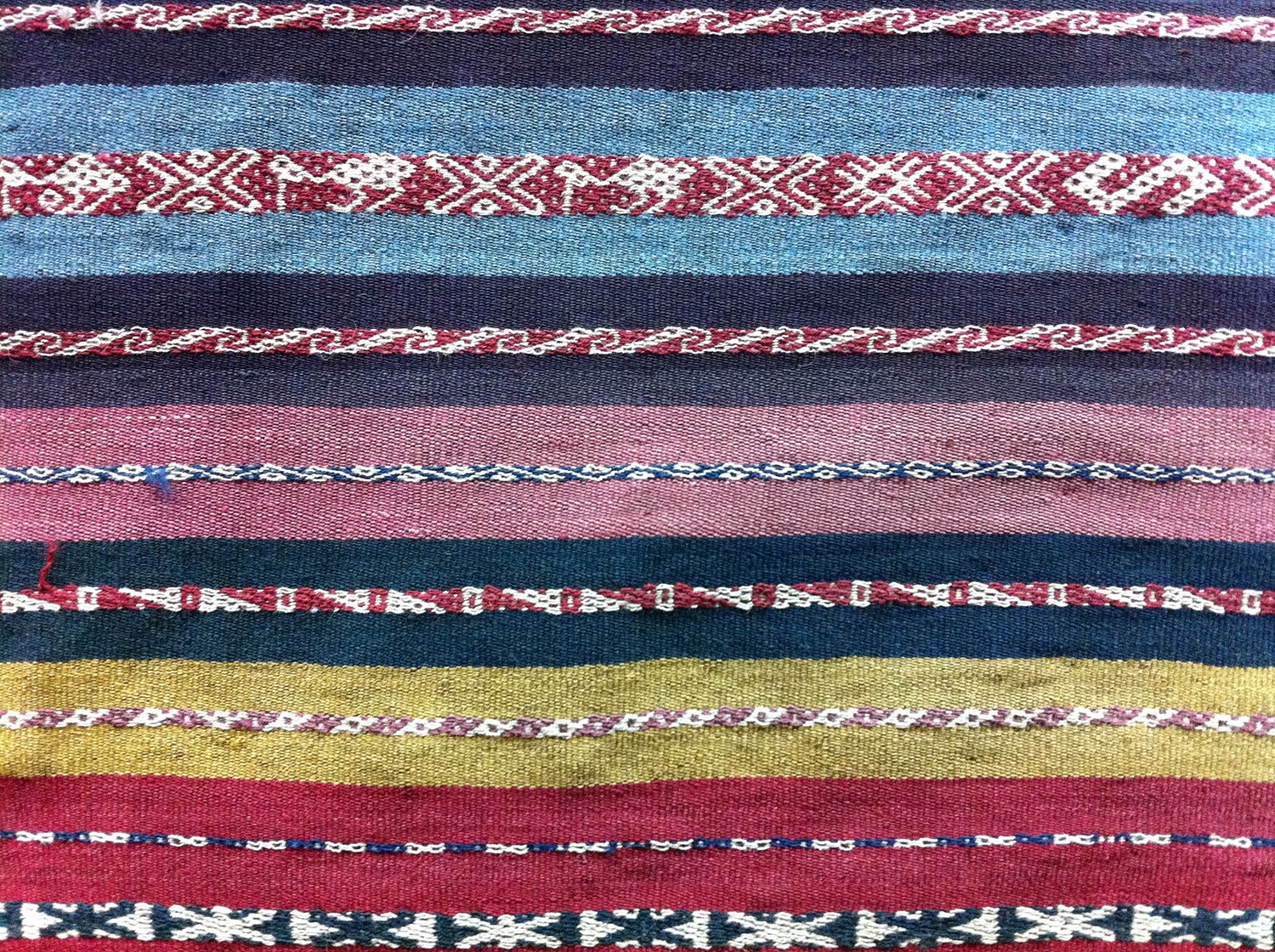
Bolívar weaving

   The rainbow

Among Aymara people, a woman is considered a fine weaver when she is able to display the rainbow on her weavings.

“People say that grandmothers used to weave quite pretty.  After the rain passed, they used to look at the kürmi (rainbow); without pointing at it though, because if you do, people say your finger may rot.  They used to imitate the colours, by looking; people say the best weaver was the one able to catch the kürmi in her weaving.  These pieces were nice.

My Mum used to say “those are k’isas”, they are sweet, because they are so nice. My godmother when she saw a weaving well done used to shout “hay mama jiwaki! Jiwaki!” which means it’s so pretty that just by looking at it you may die...”

Maríana Quispe, Aymara culture, Ch’issi community,  Department of La Paz.

   The “t’isnus”

These are narrow and thin weavings.  They are usually made by young girls, at the age of 5 or 6, while trying to learn how to weave.  It is named differently in every community.

“In Titicachi we usually keep our things in pipkins, to carry stuff we use little bags.  Now that we make crafts, we sew our bags with a machine; we’ve learned to use them.  We no longer have to buy bags!! We use t’isnus as ornaments and then we wrap up our bags with t’isnus as well.

We also use these bags for children, so they have something to carry their snacks for school.  The school is far away, sometimes they have to walk almost two hours; they need somewhere to carry their toasted corn.”

Martha Ojeda, Mollo culture, Tarisquía community, Department of La Paz.

North Potosí weaving

4 The Mama Thallas weavings

The weavings that display special designs and colours are used to establish the level of authority men and women possess in their communities.
“...when we are authorities, jilakata for men, mama thalla for women, as a couple, married, we serve our community for a year.

For this special occasion, we make specaisl awayus, red and black with designs.  We also wear a red [?] and a white hat. This is our attire for the rest of the year.  Men wear a poncho, ch’uspa and the awayu.

The community chooses us and gives us enough time to prepare, after throughout one year, just like the father and the mother take care of their children, we, the authorities, must take care of the community.

Asunta Mamani, Aymara culture, Patacamaya community, Department of La Paz.

 Calamarca weaving

5  In order to get married, you have to know how to weave

People from the layme culture in the northern region of Potosí, measure a woman’s reputatiion by her weaving skills.  A man chooses a wife according to the number of weavings she wears and how well made they are.

“When I got married, I already knew how to weave llikllas, aqsus, ch’uspas, ch’umpis, all of these pieces.  In order to get married, a woman must know how to weave; otherwise people look down on you, criticize you.  They even claim that you are not a good woman.  That’s why we have to learn how to spin, dye, and then weave from an early age.

We gather all the pieces we made througjout the year, and go to the celebration to dance.  You have to show your weavings to prove everyone you are a fine weaver.  This way mothers will look at you and think of you as a good daughter-in-law, they say, “when she gets married she’ll be able to dress her husband and children.”  A woman who is a fine weaver is cared for and respected.”

Agustina Sipe, Quechua culture, Llallawa community, Department of Potosí
6
North Potosí weaving


7  About rivers

The iconographic designs shown in textiles also represent the weaver’s worldview.  The river is a significant element, since it represents the source of life.

“We usually weave rivers; we call them mayu in quechua.  We weave them is aqsus for us, and pallay unkus for men.

A line, then switches to the right, then to the left, all the way to the end.  Sometimes we include saras as well, we call it mayu sara (river with corn) and we also include yut’us (quails).

Other women make the mayu with stars, so its like during the night time.  Do you ever see the river from the sky?  I don’t know what you call it in Spanish, we call it wara wara mayu.  That’s what we weave.  We also weave the sun, that’s simple...”

Feliciana Sipe, Yampara culture, Candelaria community, Department of Chuquisaca

  The mountain has hair and eyes

The Andean myth establishes that sacred mountains such as the Akhamani possess human attributes, like eyes and hair.

“...when I was little, my grandpa used to say that mountains were sacred by pointing to the Akhamani.  He used to say that mountains were alive and took care of the community.  He called them achachilas, the elders.  Then he would point at the animals and say that llama wool and alpaca wool are the hair of the mountains, and the little lagoons were their eyes.

He looked at us, and said that women used mountains’ hair to weave and the lagoons were those little figures – rhombuses – weavers included in the piece.  They were eyes, which took care of the weaving and the weaver.

People also say that these eyes have to be included to ask for enough water for our crops.”

Felipa Vargas, Kallawaya culture, Kañizaya community, Department of La Paz.

   About horses

The iconographic representation of the horse is related to the image of St. James – the Moor Killer – patron of Spain.  This Saint is associated to llapa, the Andean god of lightning. 

 Tarabuco weaving

“My grandmother used to say that we have to weave cawallus (horses) because that way Tata Santiago (St. James) will help.  It’s like the lightning, he gives us strength.  It’s Tata Santiago’s horse.

When I was little I used to see him at the church.  We lit a candle to keep him happy.  Then we began to weave.  We still weave the Tata’s horses.  It will bring us luck!  So we weave cawallus with flags!

We carry white flags while dancing, to attract good fortune for our crops.  That’s why we weave little horses, for good fortune.  We weave them standing up, jumping, walking, any way.... we always weave cawallus.”

Emiliana Garcia, Yampara culture, Tarabuco communtiy, Department of Chuquisaca.

 Tarabuco weaving 

Leaving the museum I felt both impressed and seriously humbled by the thousands of years of tradition compacted into each and every piece so intricate in its detail and so firmly rooted in its own local culture.  Wow.  Beautiful.  And what a vast subject matter to be brushing the surface of!

Saturday, 5 October 2013

La Paz: weavings


Waiting to organisea a visit the lakeside commuity Okola I spent another few days in La Paz exploring the museums and art galleries on a hunt for as much information and imagery about Bolivian weavings as possible.  

Jalq'a weaving, with 'khurus' mythical beings woven to keep evil spirits at bay

One of the top visits was the Museum of Andean Bolivian textiles, where not being allowed to take photos meant I paid much more attention to the information in the moment, taking loads of notes and beginning to understand a little about the characteristics that define the different weavings from different communities.   So far the only group whose weavings I can definitely recognise are those of the Jalq'a.  Acording to the exhibition notes, the Jalq'a'a weavings have embodied their identity where they have political and social organisation.  Easier than the other weavings to recognise because of their distinct colouring, they use usually red and black or pink and black and their iconography includes condors, eagles and usually also 'khurus', or 'worms', mythical creatures that are woven into the fabric to keep evil spirits at bay:

“In Potolo, mearby Sucre; we add khurus ro our llikllas, aqsus, and capotes.  We also include condors, little birds, ducks and sometimes we even include people.

A payala (grandmother) says that khurus are evil.

My grandmother, my mum’s mother, already passed away.   She used to say that we had to weave them to scare away bad spirits.  That’s why I always include these worms; so that they may scare away those who mean to hurt us... For the celebration we wear aqsus with khurus on them, always in black and red.  Sometimes we use pink, like the old pruscila; grandmothers know that tone...”

Damiana Pari, Jalq’a culture, Potolo community, Department of Chuquisaca, from “Reading the Artists from the Andes” – museum reference reading, quotes gathered from Andean weavers


Bolívar weaving

Charanzí weaving

North Potosí weaving

Manuel Tinta "Salar Con Ovillos"

Luis Alberto Quispe "Jatiri II Bruja" (detail)


Moreno mask and China Supay mask, both used at carnival in the region of LaPaz

The drawers filled with weavings in the Ethnographic Museum gave me a chance to study some more of the colours and icons of weavings from all over Bolivia, and to look at more carnival masks.  It was also interesting to see how contemporary Bolivian artists are referencing traditional weaving techniques in their work at the Museum of Contemporary Art.  And the best example of traditional-meets-contemporary: this supermarket poster.... the Bolivian version of London's Hip-Hop Housewife Lyns!!


:-) 

Oruro


Oruro - a place of carnival (at a certain time of year that was not when I went a couple of weeks ago, but signs of it were in posters, paintings and murals all over the town) and colourful markets lined with stalls selling charquekan (shredded fried llama meat - served here with cheese, maize and a boiled egg, eaten by hand) and delicious api (a purple and cream corn-based drink served with deep fried cheese pastries, a well tasty breakfast!)


Perhaps the most fascinating thing for me about Oruro is the clear interweaving of Catholicism and pre-colonial practices.   Diablo masks characteristic of carnival are painted alongside crosses and images of the Virgen Mary.


The other striking juxtaposition is religion with mining.  Like Potosí, Oruro is still an active mining town.  It somehow seems absurd to me that the conquistadors that instigated the harsh reality of mining that so exploited locals also brought along 'soul saving' Catholicism.  For some reason I imagine the locals asking themselves 'so what do these strangers offer us?  cruelty and catholicism.'  Since the abolition of slavery mining conditions have improved although they are still tough places to work.  And Catholicism it seems, has thrived.


Here on the right, a 3-tier slide where kids whizz down sat on dismantled cardboard boxes. :-)


 Casa Arte Taller - a home/art gallery I'd read about in the guide book.  Home to Gonzalo and Maria, both sculptors, and their family of daughters who are all artists in their own right, painters, sculptors and photographers.  The lovely Maria showed me around the home, a real Aladdin's cave of art, walls dripping with paintings, surfaces spilling with sculptures, ornaments and antiques.

Gonzalo's sculptures, heaving based in spheres, reference our connection with and responsibility to nature.  This figure offering up a sphere represents how all we have is loaned to us in life, and we need to be grateful of it and treasure it.  

  Maria's beautiful ceramics all revolve around Pachamama, Mother Earth.

Gonzalo kindly invited me to a local family ceremony that evening.  When I arrived to their family-neighbours home, I was surprised to see that it was a Catholic ceremony in the front room.  With a Jesus icon surrounded by gorgeous flowers, the ceremony felt very informal.  The priest leading the readings and prayers was dressed in normal clothes and ofter opened lighthearted discussions in the group. Folk came and went and  were even setting off handheld fireworks at the doorway throughout proceedings, while we were served hot peach drinks and spicy hot sandwiches.  Right at the end, after final prayers, we were offered cigarettes and coca leaves to chew and chatted into the early hours of the morning.  This was the most fascinatingly Bolivian part of the evening, and a clear example of the mixture of traditional custom with Catholicism. 

Brilliant! 
:-)

Potosí

I like this photo because the cholita painted on the wall reflects the cholitas selling fresh orange juice on the right.

Writing this from the first weekend in Cochabamba, Potosí seems like a long time ago now! I headed there from Uyuni with Chilean Viviana, where we enjoyed eating fresh mixed salads from the market out of plastic bags sat on the steps of a local square.  


We also went to visit the Potosí mines, which was a thought provoking experience, both before and after.  Before for wondering, is this an ok thing to do, is it somehow unpleasantly voyeuristic? But then thinking as the mines are the basis of the town in terms of current employment and also in terms of the town's history, fame and legend it seemed an important visit to make in order to understand the town and also a part of Bolivia's history.  Cerro Rico (meaning 'Rich Hill') was where the Spanish found silver in 1539 (according to earlier Incan legend 'other man' was destined to mine the silver, not the local folk... a mythical detail I find somehow puzzling).  This seems to have led to waves of wealth and poverty, slavery and exploitation, with the Spanish using local indigenous people and when it turned out they would rather kill themselves than be exploited, bringing in slaves from Africa to do the heavy painful work of extracting the metal.  Apparently there was a point when workers would live underground for four months at a time so that when they came out they had to be blindfolded to protect their eyes against natural light.  


Now, in 2013, the mines are exhausted of silver and mined instead for a compound mixture of lead, tin and copper which the workers, who are now organised in family-based co-operatives, sell to local extraction plants who then sell it on to foreign companies that use it in manufacturing goods which  are then sold back to Bolivia  - our Bolivian guide asked us, when have you ever seen anything "made in Bolivia"?  He reckons in order to profit from their wealth of natural resources Bolivia needs to start manufacturing in-counrty.

In our attempt to be ethical in our visit to the mine Vivi and I went with the company of ex-miners Big Deal Tours, who were funny entertaining and informative.  A group of 6 who began working in the mines as 12 year olds, they formed their tour group about 6 years ago after having worked with foreign tour groups.  Interestingly, although they say mining is a good job, one where miners earn a LOT of money, our guide also said he doesn't want his sons or nephews working in the mines (it is a family business - fathers and uncles taking young cousins and sons down to initiate them into the trade).  There are obviously huge health risks, with silicosis a notoriously common fatal lung disease.  


In the typical start to a mining tour we were taken to the miners market where shop shelves are lined with 96% drinking alcohol, cigarettes, dynamite and coca leaves.  We were encouraged to buy presents of coca leaves which the miners chew all day while they work (they don't eat on shift) and fizzy pop drinks, but NOT cigarettes or alcohol (apparently other 'less ethical' agencies encourage this, but as our guide said, why put lungs already at risk more at risk and why encourage drunkenness in already dangerous conditions.  And the conditions are tough - dark (only light are the headlamps on the hard hats which in turn are about the only sign of safety equipment used by the miners as far as we could see) - low ceilings, air heavy with mineral dust, sludge and mineral contaminated water underfoot.  The miners carry heavy loads out on their backs in sacks, or load trolleys which they push and pull in teams along metal runners to the surface - intensely heavy work.


A key figure inside Cerro Rico is el Tío (Uncle).  A character who is considered god of the underground and is a symbol of fertility (any clue to that in his stature hey?! ;-) production and protection.  Apparently since colonial times he has been confused with a devil, but seeing as miners come here to make offerings of coca, cigarettes and alcohol and to pray for safety and productivity (and drink their 96% alcohol) he can't be much of a devil.


Another figure key to the town and mining's history is this more convincingly devilish character on the far left  - Francisco Pizarro - his face is all over Potosí including this wall of our hostel.  He was the Spaniard to 'found' the town Potosí (changing its name from the local Ptojsi or Ptoj meaning "to spring forth") and to open the coin making mint, la Casa de Moneda, where his effigy now hangs intimidatingly in the entry way.  Now a museum, I was shown through the textiles, weavings and costumes rooms by this lovely local girl Paula who's about to head to Brazil to continue her studies in anthropology. (Thanks for the tour Paula!)


My first forays into the world of weavings of Bolivia, this was the very beginnings of me getting a grasp on what it means that Bolivia is a pluri-national country, made up of 36 recognised cultural groups, each using weavings in their own way to reflect and represent their culture and word views.

The costumes that most drew my attention were the Tinku costumes below, for their vivid, even fluorescent colours, and for the familiarity of the weaves that remind me of tartans!  Used in a traditional Andean ceremony that apparently involves violent combat between young men, the Tinku ceremony is celebrated in various communities, particularly in Potosí, and marks a moving from adolescence to adulthood, and a chance for communities to dance, drink and romance.


The last couple of days in Potosí were spent enjoying beers with a group from the hostel and local artisans, including Bolivian Mauro whose bag of materials included this parrot beak found in the jungle. Peculiar and fascinating...


Art raises the spirits...

big love
:-)